, commonly referred to as RDTs, have transformed modern healthcare by enabling quick and accessible medical diagnosis at the point of care. Traditionally,...
Rapid Diagnostic Tests, commonly referred to as RDTs, have transformed modern healthcare by enabling quick and accessible medical diagnosis at the point of care. Traditionally, diagnostic testing often required centralized laboratory facilities, specialized equipment, and extended waiting periods before results became available. Such delays could postpone treatment decisions, increase healthcare costs, and contribute to the spread of infectious diseases.
Key takeaways
Enable rapid point of care diagnosis, allowing immediate treatment decisions, isolation, or additional testing.
Operate via simple workflows: sample collection, reagent interaction, detection using lateral flow or microfluidics, and visual or digital result interpretation.
Accuracy and quality control challenges may require confirmatory testing; digital, multiplex, CRISPR, and wearable innovations aim to enhance reliability.
The emergence of rapid diagnostic technologies has significantly altered this landscape. By providing results within minutes rather than days, these tests support timely clinical decisions and expand access to healthcare services in both advanced medical settings and resource limited environments. Their growing integration into hospitals, clinics, pharmacies, and home healthcare reflects their importance in contemporary medical practice.
Understanding Rapid Diagnostic Tests
Rapid Diagnostic Tests are medical assays specifically designed to detect diseases, biological markers, or physiological conditions quickly and efficiently. They are often categorized as point of care tests because they can be performed near the patient rather than in centralized laboratories.
Unlike conventional diagnostic methods that require extensive processing and trained laboratory personnel, RDTs are typically designed for simplicity and portability. Most tests involve straightforward procedures that can be completed with minimal training. Their compact design also allows them to be used in diverse settings, including rural clinics, emergency departments, and home environments.
One of the defining characteristics of RDTs is their speed. Results are commonly available within five to thirty minutes, enabling healthcare providers to make immediate decisions regarding treatment, isolation measures, or additional testing. Their cost effectiveness further enhances their utility, particularly in healthcare systems with limited resources.
Mechanisms and Operational Principles
Although rapid diagnostic technologies vary in design and complexity, they generally follow a similar operational sequence involving sample collection, reagent interaction, detection, and result interpretation.
The first step involves collecting a biological sample from the patient. Depending on the purpose of the test, this sample may consist of blood obtained through a finger prick, a nasal or throat swab, urine, saliva, or another biological fluid.
Following collection, the sample is combined with reagents or buffer solutions. These substances help isolate or expose the target molecules being tested, such as antigens, antibodies, or nucleic acids. The reagents facilitate the biochemical reactions necessary for accurate detection.
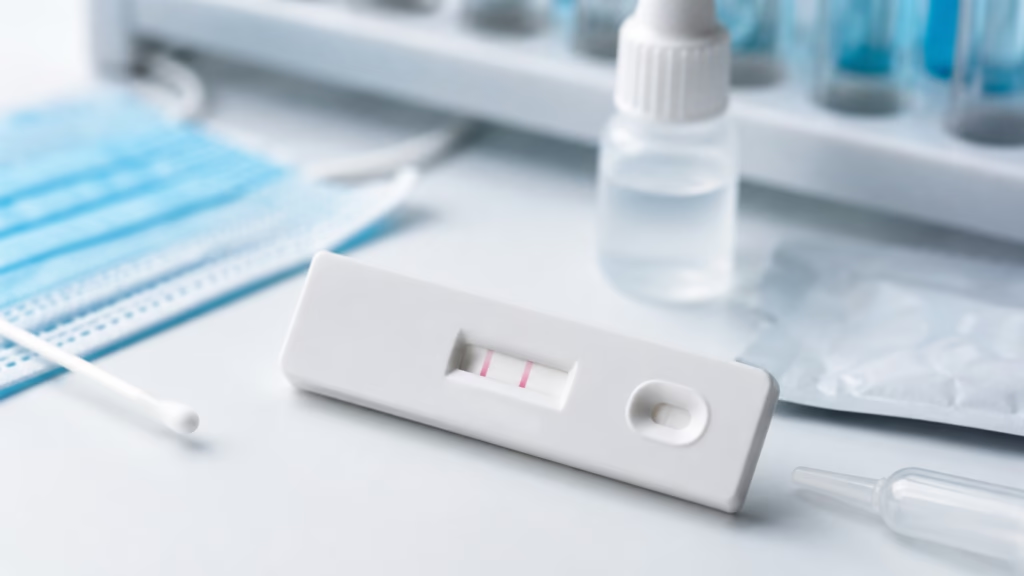
The detection process differs according to the specific technology employed. One of the most common formats is the lateral flow immunoassay. In this system, the sample moves along a test strip through capillary action. If the target substance is present, it binds to specific antibodies embedded within the strip, producing a visible colored line. Pregnancy tests are a widely recognized example of this approach.
More advanced RDT platforms use microfluidic or cartridge based systems. These technologies guide the sample through miniature channels and reaction chambers, where automated biochemical reactions occur. Electronic readers then analyze the reactions and provide digital outputs.
The final stage involves interpretation of results. Some tests rely on visual indicators such as colored bands, while others use handheld devices to display numerical or graphical information. Digital interpretation improves precision and reduces the risk of human error.
Advantages of Rapid Diagnostic Tests
Rapid Diagnostic Tests provide several important benefits that have contributed to their widespread adoption across healthcare systems.
One major advantage is the acceleration of clinical decision making. Immediate test results allow healthcare providers to diagnose conditions and initiate treatment during the same patient encounter. This rapid response is especially important in infectious disease management, where early isolation and therapy can reduce transmission and improve outcomes.
RDTs also expand healthcare accessibility. In regions lacking advanced laboratory infrastructure, portable and simple diagnostic tools provide essential testing capabilities that would otherwise be unavailable. This contributes significantly to disease control efforts in underserved populations.
Another important benefit is the reduction of workload on centralized laboratories. By handling routine or preliminary testing at the point of care, RDTs allow laboratory personnel to focus on more complex analyses requiring specialized expertise.
Patient empowerment is also enhanced through home based diagnostic kits. Individuals can monitor conditions such as pregnancy, blood glucose levels, or infectious disease exposure independently, promoting greater engagement in personal healthcare management.
From an economic perspective, RDTs can reduce healthcare expenditures by minimizing unnecessary hospital admissions, shortening treatment delays, and limiting the spread of communicable diseases.
Applications Across Medical Fields
Rapid Diagnostic Tests have become integral to numerous areas of medicine due to their versatility and efficiency.
In infectious disease management, RDTs are widely used for detecting viral, bacterial, and parasitic infections. COVID-19 antigen tests, for example, enabled large scale screening during the global pandemic. Malaria RDTs have been particularly valuable in remote regions where laboratory microscopy is unavailable. Rapid tests for streptococcal infections allow clinicians to quickly identify bacterial throat infections and initiate appropriate treatment.
In chronic disease management, portable glucose meters have revolutionized diabetes care by enabling continuous self monitoring of blood sugar levels. Cholesterol testing kits similarly support cardiovascular risk assessment and preventive care.
Women’s health has also benefited substantially from rapid testing technologies. Over the counter pregnancy tests provide early detection of pregnancy through hormone analysis, while ovulation kits assist individuals in identifying fertility windows.
Veterinary medicine represents another important application area. Rapid tests for conditions such as parvovirus or Lyme disease enable veterinarians to diagnose and manage illnesses efficiently during routine clinical visits.
Challenges and Limitations
Despite their many advantages, Rapid Diagnostic Tests also face important limitations that must be acknowledged.
One major concern involves diagnostic accuracy. Some rapid tests may produce false positive or false negative results due to limitations in sensitivity or specificity. Consequently, confirmatory laboratory testing is sometimes necessary, particularly in cases involving serious or uncertain diagnoses.
Quality control presents another challenge. Variability in manufacturing standards, storage conditions, and environmental exposure can influence test performance. Excessive heat, humidity, or improper handling may compromise reliability.
Regulatory oversight is essential to ensure safety and effectiveness. Different regions maintain varying standards through agencies such as the United States Food and Drug Administration, the European CE marking system, and the World Health Organization. Maintaining compliance across international markets can be complex.
User related factors also influence outcomes. Incorrect sample collection, inaccurate timing, or improper interpretation can affect test validity. Therefore, clear instructions and adequate user education remain important components of successful implementation.
Future Directions and Emerging Innovations
The future of rapid diagnostic testing is characterized by rapid technological advancement and increasing integration with digital health systems.
One promising development involves smartphone based diagnostic platforms. Mobile applications combined with built in cameras and artificial intelligence algorithms can analyze test strips with greater precision than visual interpretation alone. Cloud connectivity further enables real time data sharing and epidemiological monitoring.
Multiplex testing technologies are also expanding. These systems allow a single test cartridge to simultaneously detect multiple pathogens, improving efficiency and reducing the need for repeated testing. For example, combined respiratory panels may identify influenza, respiratory syncytial virus, and COVID-19 in one procedure.
CRISPR based diagnostics represent another major innovation. By leveraging gene editing technologies for molecular detection, these assays offer exceptionally high sensitivity and rapid processing times. Such developments may significantly improve early disease detection in the future.
Wearable biosensors are emerging as an additional frontier in diagnostics. These devices continuously monitor physiological biomarkers through sweat or interstitial fluids, enabling real time assessment of health status and early identification of abnormalities.
Conclusion
Rapid Diagnostic Tests have fundamentally transformed the practice of modern medicine by bringing fast, accessible, and cost effective diagnostics directly to the point of care. Their ability to deliver timely results enhances clinical decision making, expands healthcare access, and empowers patients to participate more actively in their own health management.
Although challenges related to accuracy, quality control, and regulatory oversight remain, ongoing technological innovation continues to improve the reliability and scope of these diagnostic tools. The integration of artificial intelligence, molecular technologies, and wearable systems suggests that rapid diagnostics will become even more precise and personalized in the future.
As healthcare systems continue to prioritize early detection, preventive medicine, and decentralized care, Rapid Diagnostic Tests are likely to remain central to the evolution of global healthcare delivery.
Disclaimer
This article is for educational purposes only and does not replace professional medical advice, diagnosis, or treatment. Seizures, severe headache, confusion, visual changes, or blood pressure readings in the hypertensive crisis range require urgent medical evaluation.
Thank you! Your feedback helps us improve our articles.
True Impact Health articles are written by our editorial team and based on reliable sources such as public health agencies, clinical guidelines and peer-reviewed research. This article has not yet been medically reviewed. Read our editorial process.
This content is for general information and is not a substitute for professional medical advice, diagnosis or treatment.