Introduction
The ability to detect extremely small amounts of genetic material has transformed modern medicine, research, and forensic science. Among the most important tools enabling this capability is Polymerase Chain Reaction, commonly known as PCR. This technique allows scientists to identify and analyze specific DNA sequences even when only minute quantities are present in a sample.
PCR has become widely recognized due to its use in infectious disease testing, particularly during global health events such as the COVID-19 pandemic. However, its relevance extends far beyond this context. It plays a central role in diagnosing genetic disorders, identifying pathogens, and supporting advanced research in molecular biology. Understanding how PCR works provides valuable insight into how modern diagnostics achieve both precision and speed.
What Is PCR?
Polymerase Chain Reaction is a laboratory technique designed to amplify a specific segment of DNA. Amplification refers to the process of creating many copies of a targeted DNA sequence from a very small initial sample. This capability is essential because many biological samples contain only trace amounts of genetic material, which would otherwise be too limited for analysis.
The method was developed in 1983 by Kary Mullis, whose work fundamentally changed molecular biology and earned him the Nobel Prize in Chemistry. PCR enables scientists and clinicians to isolate and study specific genes, detect pathogens, and perform detailed genetic analysis with high accuracy.
The technique supports several critical functions. First, it allows for the detection of extremely small quantities of DNA that would not be observable through conventional methods. Second, it enables detailed examination of genetic sequences, which is important for identifying mutations or variations. Third, it significantly reduces the time required for diagnostic testing, making it possible to obtain results within hours rather than days.
How Does PCR Work?
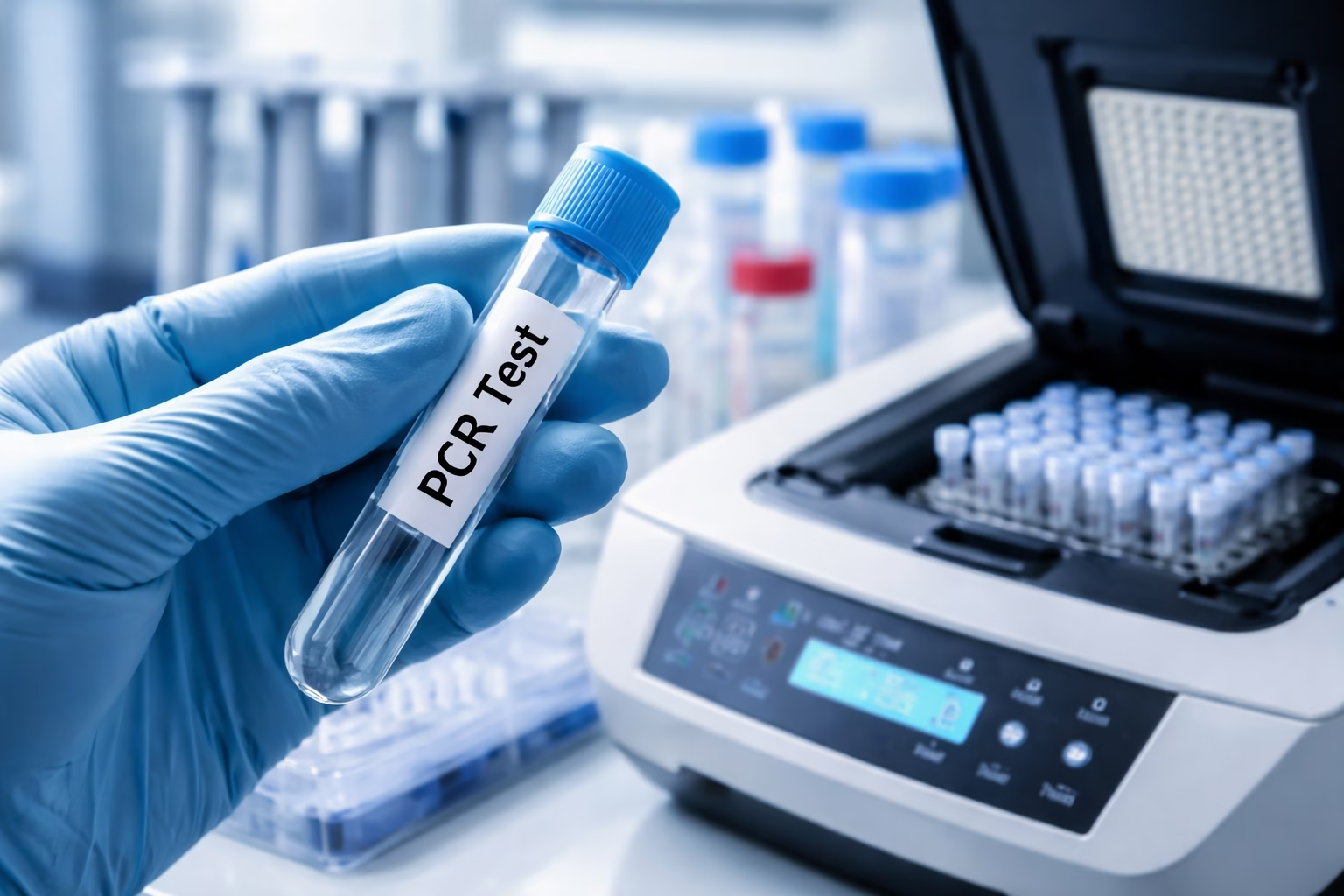
PCR operates through a repeating cycle of temperature changes that drive specific biochemical reactions. These cycles are carried out in a machine known as a thermal cycler. Each cycle consists of three essential stages, and the repetition of these stages leads to exponential amplification of the target DNA.
Denaturation
During the first stage, the DNA sample is heated to a high temperature, typically between 94 and 98 degrees Celsius. At this temperature, the hydrogen bonds that hold the two strands of the DNA double helix together are broken. As a result, the double-stranded DNA separates into two single strands.
This step is essential because it exposes the genetic sequence that will be copied. Without separating the strands, the replication process cannot begin.
Annealing
In the second stage, the temperature is lowered to a range of approximately 50 to 65 degrees Celsius. At this point, short DNA sequences known as primers bind to specific regions on the single-stranded DNA. These primers are carefully designed to match the beginning and end of the target sequence.
The accuracy of this step is critical. If the primers bind correctly, they define the exact segment of DNA that will be amplified. If they bind incorrectly, it may lead to non-specific amplification, which can affect the reliability of the results.
Extension
The third stage occurs at around 72 degrees Celsius. During this phase, a specialized enzyme called DNA polymerase begins synthesizing a new DNA strand. The most commonly used enzyme is Taq polymerase, which is derived from heat-resistant bacteria and can function at high temperatures.
Starting from the primers, the enzyme adds nucleotides one by one, building a complementary strand of DNA. This results in the formation of two double-stranded DNA molecules from the original single strands.
Exponential Amplification
These three steps are repeated multiple times, usually between 25 and 40 cycles. With each cycle, the number of DNA copies doubles. This exponential growth means that a single DNA molecule can be amplified into millions or even billions of copies within a relatively short period.
This amplification is what makes PCR so powerful. It transforms a barely detectable genetic signal into a measurable and analyzable quantity.
Common Types of PCR
Over time, PCR technology has evolved into several specialized forms, each designed to meet specific scientific or clinical needs.
Conventional PCR
Conventional PCR is the original form of the technique. In this method, the amplified DNA is analyzed at the end of the process using gel electrophoresis. This allows scientists to determine whether the target DNA is present based on the size and position of the DNA fragments.
However, this method does not provide information about how much DNA was present initially. It is therefore considered qualitative rather than quantitative.
Real-Time PCR (qPCR)
Real-time PCR, also known as quantitative PCR, allows scientists to monitor DNA amplification as it occurs. This is achieved using fluorescent markers that emit signals proportional to the amount of DNA produced during each cycle.
This approach is particularly useful in clinical diagnostics because it enables both detection and quantification of genetic material. For example, it can be used to estimate viral load in infectious diseases.
Reverse Transcription PCR (RT-PCR)
Reverse transcription PCR is used when the starting material is RNA rather than DNA. In this process, RNA is first converted into complementary DNA using an enzyme called reverse transcriptase. The resulting DNA is then amplified using standard PCR techniques.
This method is essential for detecting RNA viruses, including COVID-19, because their genetic material is not DNA.
Digital PCR
Digital PCR is a more advanced variation that divides a sample into thousands of small partitions. Each partition undergoes amplification independently. By counting how many partitions contain the target DNA, scientists can obtain highly precise and absolute quantification.
This method is particularly valuable in research and specialized diagnostics where very high sensitivity and accuracy are required.
Key Applications of PCR Testing
Medical Diagnostics
PCR has become a cornerstone of modern medical diagnostics. It is widely used to detect infectious diseases by identifying the genetic material of pathogens such as viruses and bacteria. For instance, PCR testing can confirm infections such as HIV, tuberculosis, and COVID-19 with high sensitivity.
In addition, PCR plays a role in identifying genetic disorders. By analyzing specific genes, clinicians can detect mutations associated with conditions such as cystic fibrosis or sickle cell anemia. In oncology, PCR is used to identify genetic changes in tumors, which can guide treatment decisions and prognosis.
Forensic Science
In forensic investigations, PCR allows for the analysis of very small biological samples. DNA from sources such as hair, blood, or skin cells can be amplified and compared to known profiles. This has greatly enhanced the accuracy and reliability of criminal investigations.
PCR is also used in paternity testing. By comparing genetic markers between individuals, it is possible to establish biological relationships with a high degree of certainty.
Research and Biotechnology
PCR is an essential tool in scientific research. It is used in gene cloning, DNA sequencing preparation, and the study of gene expression. Researchers rely on PCR to replicate specific DNA segments for detailed analysis.
In environmental science, PCR helps detect microbial contamination in water and food. In agriculture, it is used to verify genetic modifications in crops and ensure compliance with regulatory standards.
Advantages of PCR Testing
PCR offers several significant advantages that have contributed to its widespread adoption.
High Sensitivity
One of the most important strengths of PCR is its ability to detect extremely small amounts of DNA. Even a few copies of a genetic sequence can be amplified to detectable levels. This makes it particularly valuable in early-stage disease detection.
Rapid Results
Compared to traditional laboratory methods, PCR is relatively fast. Results can often be obtained within a few hours, which is critical in clinical settings where timely diagnosis is essential.
High Specificity
The use of carefully designed primers ensures that only the target DNA sequence is amplified. This reduces the likelihood of detecting unrelated genetic material and enhances the accuracy of the test.
Versatility
PCR can be adapted for a wide range of applications, including DNA and RNA analysis. Its flexibility allows it to be used in clinical diagnostics, research, forensic science, and environmental monitoring.
Limitations and Challenges
Despite its strengths, PCR is not without limitations.
Risk of Contamination
Because PCR is highly sensitive, even small amounts of contaminating DNA can lead to false positive results. This requires strict laboratory procedures and careful handling of samples.
Complexity of Primer Design
The success of PCR depends heavily on the design of primers. Poorly designed primers can bind to unintended sequences, resulting in inaccurate amplification and unreliable results.
Cost Considerations
PCR requires specialized equipment such as thermal cyclers, as well as high-quality reagents. These costs can be a barrier in resource-limited settings.
Quantification Limitations
Traditional PCR provides only qualitative results, indicating whether a target sequence is present or absent. Although advanced methods such as real-time PCR address this limitation, they add complexity and cost to the process.
Best Practices for Reliable PCR Results
Ensuring accurate PCR results requires careful attention to laboratory procedures and quality control.
Laboratory Separation
Maintaining separate areas for sample preparation and analysis helps reduce the risk of contamination. This physical separation is a key component of reliable PCR workflows.
Primer Validation
Primers should be tested using computational tools and pilot experiments before use. This helps confirm that they bind specifically to the intended target sequence.
Use of Controls
Including positive, negative, and internal controls is essential for verifying the accuracy of results. Controls help identify potential errors such as contamination or reaction failure.
Equipment Maintenance
Thermal cyclers and other equipment must be regularly calibrated and maintained. Consistent temperature control is critical for the success of the PCR process.
Conclusion
Polymerase Chain Reaction remains one of the most influential techniques in modern science. Its ability to amplify tiny amounts of genetic material has enabled breakthroughs in medical diagnostics, forensic investigations, and biological research.
By understanding the fundamental steps of denaturation, annealing, and extension, it becomes clear how PCR transforms a small genetic signal into a powerful source of information. Although challenges such as contamination risk and cost must be carefully managed, the benefits of PCR in terms of sensitivity, speed, and specificity are substantial.
As scientific technology continues to advance, PCR is likely to remain a foundational tool. Its role in uncovering genetic information ensures that it will continue to contribute to improved healthcare outcomes, more accurate diagnostics, and deeper insights into the biological processes that shape human health.
Further Reading
3.5 tog sleeping bag temperature guide
What Type of Psychotherapy Is Best for Anxiety?