




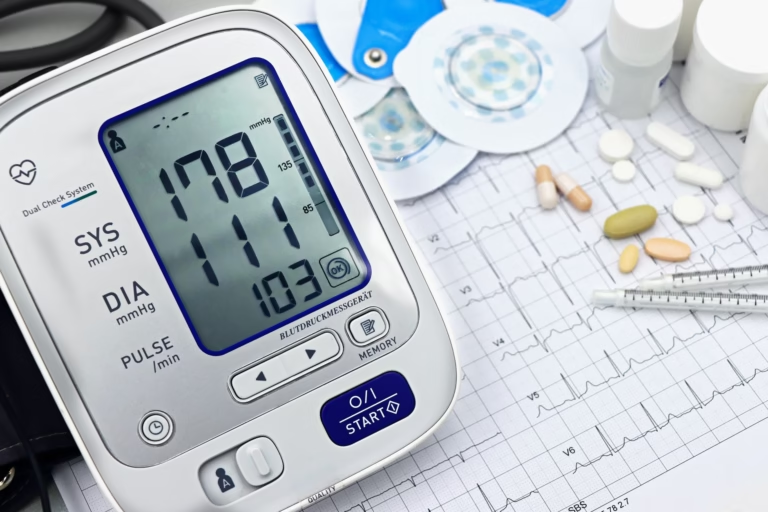










Acute Diastolic Congestive Heart Failure is Reported with Code I50.31
Accurate medical coding is an essential component of modern healthcare. It supports proper reimbursement, facilitates communication among healthcare...

Table of Contents
Introduction
Accurate medical coding is an essential component of modern healthcare. It supports proper reimbursement, facilitates communication among healthcare providers, contributes to quality reporting initiatives, and helps maintain accurate patient records. Among cardiovascular conditions, heart failure remains one of the most commonly diagnosed and coded diseases. Because heart failure can present in different forms and levels of severity, selecting the correct ICD-10-CM code is critical.
One specific diagnosis frequently encountered in clinical practice is acute diastolic congestive heart failure, which is reported using ICD-10-CM code I50.31. This condition occurs when the heart experiences a sudden decline in its ability to fill properly during the relaxation phase of the cardiac cycle, resulting in congestion and fluid accumulation throughout the body. Understanding the clinical characteristics of acute diastolic heart failure and the correct application of ICD-10 code I50.31 helps ensure accurate documentation, coding compliance, and effective patient management.
This comprehensive guide explains acute diastolic congestive heart failure, outlines the significance of precise coding, reviews the appropriate use of ICD-10-CM code I50.31, and highlights important documentation considerations for healthcare professionals and medical coders.
Understanding Acute Diastolic Congestive Heart Failure
Diastolic heart failure, commonly referred to as heart failure with preserved ejection fraction (HFpEF), occurs when the ventricles of the heart become stiff and less compliant. Although the heart may still pump out a normal percentage of blood with each contraction, the ventricles cannot relax adequately during the filling phase. As a result, the heart cannot fill with enough blood between beats, leading to increased pressure within the heart chambers and lungs.
When this condition develops suddenly or when symptoms worsen rapidly, it is classified as acute diastolic congestive heart failure. Patients often experience a sudden onset of breathing difficulties, fluid retention, fatigue, and exercise intolerance. These symptoms may progress quickly and frequently require urgent medical evaluation or hospitalization.
Unlike systolic heart failure, which is characterized by a reduced pumping ability of the heart, diastolic heart failure primarily involves impaired relaxation and filling of the ventricles. The heart muscle becomes stiff, making it difficult for blood to enter the chambers efficiently. This elevated filling pressure can cause fluid to back up into the lungs and surrounding tissues, resulting in congestion and respiratory distress.
Acute diastolic heart failure is particularly common among older adults, individuals with long-standing hypertension, patients with diabetes, and those with left ventricular hypertrophy. Because many patients maintain a normal ejection fraction, diagnosis often requires careful clinical assessment and specialized testing.
Why Accurate ICD-10 Coding Matters
Accurate ICD-10 coding serves several important purposes beyond simple billing and reimbursement. Diagnosis codes create a standardized language that enables healthcare providers, insurance companies, researchers, and public health organizations to communicate effectively about patient conditions.
When acute diastolic congestive heart failure is documented and coded correctly, healthcare teams gain a clear understanding of the patient’s clinical status. This improves care coordination, treatment planning, and continuity of care across multiple providers and healthcare settings.
Accurate coding also directly affects reimbursement. Insurance payers and government programs such as Medicare use ICD-10 diagnosis codes to determine payment levels and medical necessity. Incorrect coding may result in claim denials, delayed payments, underpayment, or compliance issues.
Furthermore, ICD-10 codes contribute to quality reporting programs, population health studies, and clinical research. Healthcare organizations rely on accurate diagnosis data to monitor outcomes, identify trends, and evaluate treatment effectiveness. Therefore, precise coding benefits not only individual patients but also the broader healthcare system.
ICD-10-CM Code I50.31 Explained
The ICD-10-CM code assigned to acute diastolic congestive heart failure is I50.31.
This code specifically identifies patients experiencing an acute episode of diastolic heart failure characterized by congestion and fluid overload. The designation allows healthcare providers and payers to distinguish this condition from other forms of heart failure that may require different management strategies and reimbursement considerations.
Within the ICD-10-CM classification system, several related codes exist for diastolic heart failure. Understanding the differences among these codes is essential for accurate code assignment.
I50.30 represents unspecified diastolic congestive heart failure and should only be used when the provider documents diastolic heart failure without specifying whether it is acute, chronic, or acute on chronic.
I50.31 represents acute diastolic congestive heart failure and is assigned when the provider specifically documents an acute episode.
I50.32 is used for chronic diastolic congestive heart failure when the condition is longstanding and stable without evidence of acute exacerbation.
I50.33 represents acute on chronic diastolic congestive heart failure and applies when a patient with an existing chronic condition experiences a sudden worsening of symptoms.
Selecting the correct code requires careful review of physician documentation and clinical findings.
Clinical Features of Acute Diastolic Congestive Heart Failure
Patients with acute diastolic congestive heart failure typically present with symptoms that develop suddenly or worsen significantly over a short period. Shortness of breath is often the most prominent complaint and may occur during physical activity or even while resting.
Many patients report difficulty breathing when lying flat, a symptom known as orthopnea. Others may experience paroxysmal nocturnal dyspnea, which involves waking suddenly from sleep due to severe shortness of breath. Fatigue, weakness, and exercise intolerance are also common because the heart cannot efficiently meet the body’s circulatory demands.
As fluid accumulates within the body, swelling may develop in the legs, ankles, feet, or abdomen. Patients may also notice rapid weight gain caused by fluid retention. In severe cases, pulmonary congestion can lead to significant respiratory distress requiring emergency intervention.
During physical examination, healthcare providers may identify elevated jugular venous pressure, peripheral edema, pulmonary crackles, and signs of fluid overload. These findings help support the diagnosis of acute heart failure.
Diagnostic Evaluation
The diagnosis of acute diastolic congestive heart failure requires a combination of clinical assessment, imaging studies, and laboratory testing.
Echocardiography plays a central role in diagnosis. An echocardiogram often demonstrates preserved left ventricular ejection fraction, typically greater than or equal to 50 percent, along with evidence of impaired ventricular relaxation and elevated filling pressures. Many patients also exhibit left ventricular hypertrophy due to chronic hypertension.
Laboratory testing frequently reveals elevated levels of B-type natriuretic peptide (BNP) or N-terminal pro-BNP (NT-proBNP), both of which are markers of cardiac stress and heart failure.
Chest radiography may demonstrate pulmonary vascular congestion, pulmonary edema, or cardiomegaly. Additional testing may be performed to identify contributing factors such as myocardial ischemia, arrhythmias, uncontrolled hypertension, or valvular heart disease.
These diagnostic findings help confirm the presence of acute diastolic heart failure and support the assignment of ICD-10 code I50.31.
Coding Guidelines and Best Practices
Assigning ICD-10-CM code I50.31 requires clear and complete physician documentation. The medical record should specifically indicate that the patient has acute diastolic congestive heart failure.
Coders should carefully review physician progress notes, discharge summaries, consultation reports, imaging results, and diagnostic findings to ensure that all elements of the diagnosis are present. Documentation should clearly identify the condition as acute, specify that it is diastolic heart failure, and confirm the presence of congestion or fluid overload.
When documentation lacks specificity, coders should avoid making assumptions. Instead, a provider query may be necessary to clarify whether the heart failure is systolic, diastolic, combined, acute, chronic, or acute on chronic.
Coders should also review the record for associated conditions that may require additional codes. Common examples include hypertension, coronary artery disease, diabetes mellitus, chronic kidney disease, atrial fibrillation, and valvular disorders.
Accurate sequencing is equally important. When acute diastolic congestive heart failure is the primary reason for admission or treatment, I50.31 is generally reported as the principal diagnosis. Secondary diagnoses should be coded according to official ICD-10-CM guidelines and payer requirements.
Common Coding Mistakes to Avoid
One of the most common coding errors involves assigning I50.31 when documentation actually supports chronic diastolic heart failure or acute on chronic diastolic heart failure. Coders should carefully verify the provider’s wording before selecting a code.
Another frequent mistake is using an unspecified heart failure code when the documentation contains sufficient detail to support a more specific diagnosis. ICD-10-CM encourages the highest level of specificity whenever possible.
Failure to capture related conditions is another common issue. Patients with acute diastolic heart failure often have significant comorbidities that influence treatment and reimbursement. Accurate reporting requires identifying and coding all clinically relevant diagnoses.
Finally, coders should avoid relying solely on test results. While echocardiograms and laboratory studies provide valuable clinical evidence, the provider must document the diagnosis before a code can be assigned.
Practical Coding Example
Consider a 74-year-old woman with a history of hypertension who arrives at the emergency department complaining of worsening shortness of breath, fatigue, and swelling in her lower extremities. She reports that her symptoms have progressed rapidly over the past three days.
Physical examination reveals elevated jugular venous pressure, bilateral leg edema, and pulmonary crackles. Laboratory testing shows elevated BNP levels. Echocardiography demonstrates a preserved ejection fraction of 60 percent along with evidence of impaired ventricular relaxation and left ventricular hypertrophy.
The physician documents “acute diastolic congestive heart failure secondary to hypertensive heart disease.”
In this scenario, ICD-10-CM code I50.31 would be assigned for acute diastolic congestive heart failure. Additional codes would be reported for the patient’s hypertension and any other documented conditions according to official coding guidelines.
Conclusion
Acute diastolic congestive heart failure is a serious cardiovascular condition that results from impaired ventricular relaxation and elevated filling pressures despite preserved pumping function. Patients frequently present with sudden shortness of breath, fluid retention, fatigue, and signs of pulmonary congestion that require prompt medical attention.
In ICD-10-CM, this condition is accurately reported using code I50.31. Proper assignment of this code depends on clear physician documentation, careful review of clinical findings, and adherence to official coding guidelines. Accurate coding improves clinical communication, supports appropriate reimbursement, strengthens quality reporting initiatives, and contributes to reliable healthcare data.
Healthcare providers and coding professionals should work collaboratively to ensure that documentation clearly identifies the type and acuity of heart failure. By understanding the clinical features of acute diastolic congestive heart failure and applying code I50.31 correctly, organizations can improve compliance, enhance patient care, and maintain the highest standards of coding accuracy.
Disclaimer
This article is for educational purposes only and does not replace professional medical advice, diagnosis, or treatment. Seizures, severe headache, confusion, visual changes, or blood pressure readings in the hypertensive crisis range require urgent medical evaluation.
Was this page helpful?
Thanks for your feedback! What could we improve?
Thank you! Your feedback helps us improve our articles.
True Impact Health articles are written by our editorial team and based on reliable sources such as public health agencies, clinical guidelines and peer-reviewed research. This article has not yet been medically reviewed. Read our editorial process.
This content is for general information and is not a substitute for professional medical advice, diagnosis or treatment.